The Archive Folio
- May 5, 2026
- ByChristopher Ludgate
At its best, a luxury hotel experience transcends the mere provision of a comfortable bed and attentive service; it encompasses thoughtful elements of culture, opulence, design, and exclusivity comparable to the world's great art houses. Many celebrated museums and salons around the globe were once prestigious palaces and historic homes and residences themselves — the Frick Collection in New York, the Louvre in Paris — spaces where the boundary between domestic grandeur and cultural treasure was always delightfully porous. While these sanctuaries delight guests with curated treasures assembled over centuries, the best luxury hotels share these very qualities while showcasing attentive hospitality, refined amenities, and lavish comforts that no museum can offer.
It was this realization that inspired me to blur the lines a bit and immerse myself in a perfect pairing: a stay at the historic Hotel Adlon Kempinski in Berlin, paired with a three-day pass to explore the stunning collections at the city's Museum Island. The combination promised an experience where the art of living and the art of history would intertwine, where each day would end not in a hotel room but in a grand residence worthy of the treasures I had spent the day admiring.
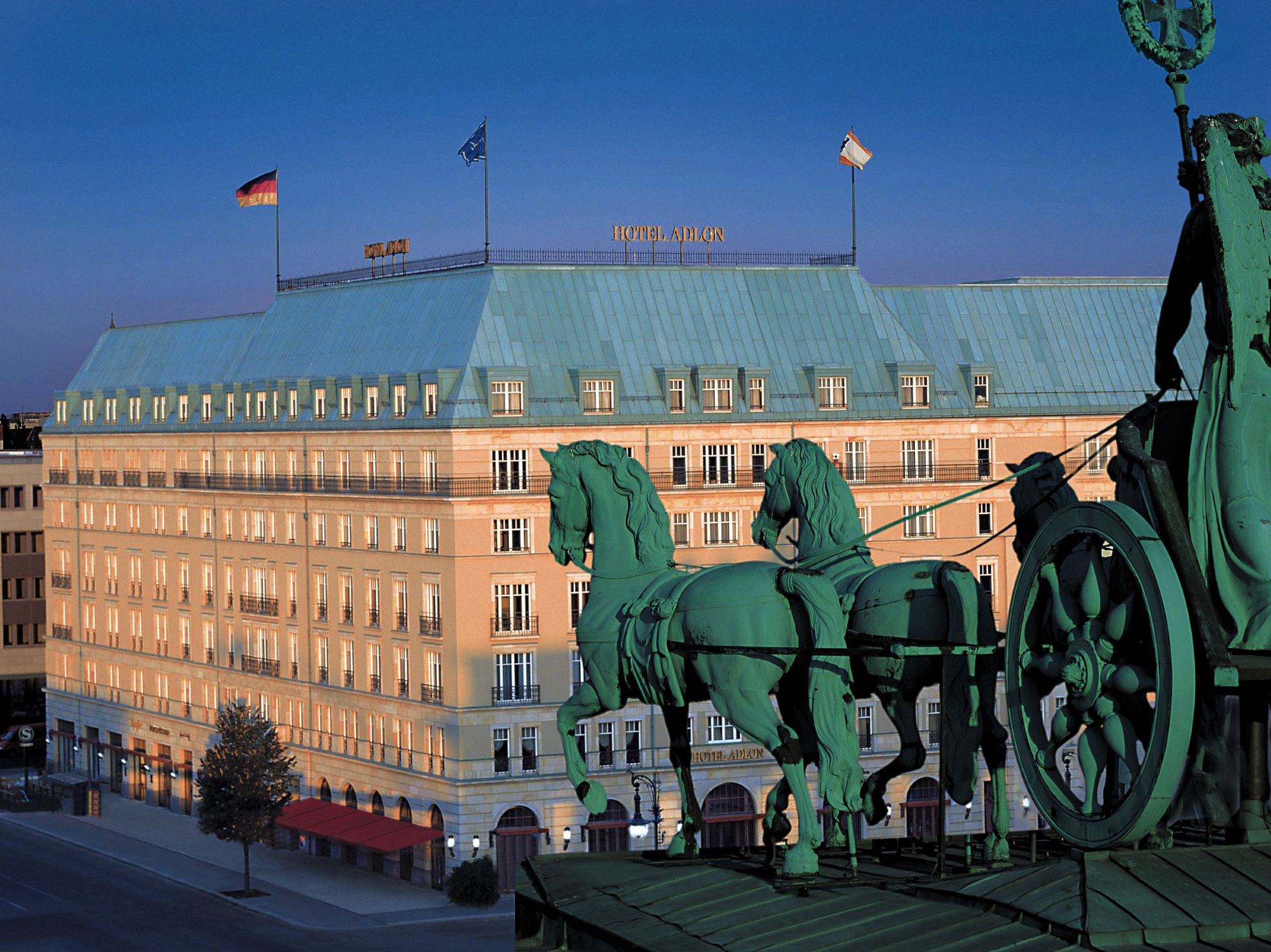
Photo Courtesy Hotel Adlon-Kempinski
Iconic Glamour
I stood at one of the French balconies in the living room of my Pariser Platz Suite at the iconic five-star Hotel Adlon Kempinski, admiring the evening's glow on the historic Brandenburg Gate just outside, and I understood immediately why this hotel has been the choice of the world's most discerning travelers for more than a century. Pedestrians lingered in the sprawling Pariser Platz below, marveling at the 235-year-old monument that has witnessed the full sweep of German history — from imperial grandeur to division and reunification. Visits from royals and rock stars, intellectuals and artists, tyrants and heads of state are among the many tales told within these walls, each one adding another layer to the hotel's already rich tapestry of legend.
The legendary landmark was bathed in ambience as a street musician struck romantic chords that drifted upward through the warm evening air. I leaned into the frame, sipping champagne, knowing that this was indeed the best view in the house — if not the entire city. There is something about watching Berlin from this vantage point that makes you feel as though you are standing at the very crossroads of history, where past and present converge in a single, breathtaking panorama.
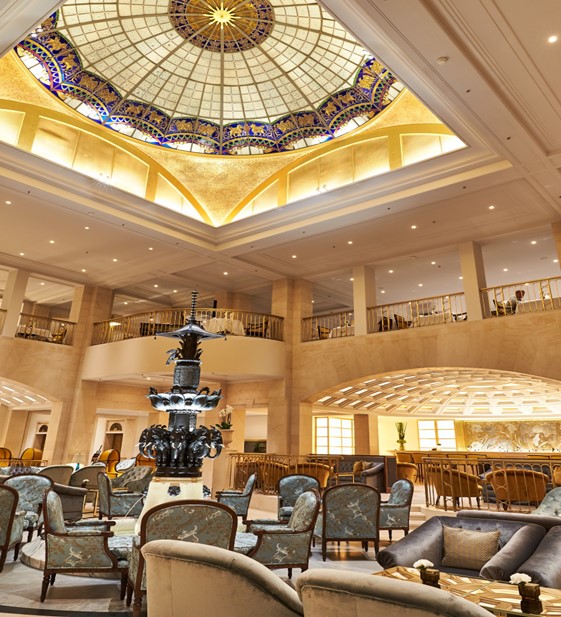
Ushered in on a red carpet upon my arrival earlier that day, I was instantly awash in old-world glamour, drenched in the warm light emanating from the lobby's dynamic, luxe, golden-coffered ceiling designed by Jagdfeld — a ceiling that seems to capture and hold the light in a way that makes even the grayest Berlin afternoon feel gilded. A 24-carat gold mosaic framed a Murano dome above the Elephant Fountain, both exact replicas that recreate the splendor of Adlon's early days as a preeminent full-amenity luxury hotel. Coveted seats by the fountain, behind the velvet rope, welcomed reservations for visitors who simply wanted to lounge in the hotel's timeless atmosphere with gold-leaf powdered bites, champagne, and perhaps some caviar — a scene that feels as though it could have been plucked from the pages of a Joseph Roth novel.
For those with a taste for cigars and whiskey, the cozy, low-key Elephant Bar awaits just beyond reception, a dimly lit sanctuary where the rituals of contemplation and conversation unfold at their own unhurried pace. The bar is a reminder that true luxury is not always about spectacle; sometimes it is about the quiet pleasure of a perfectly poured drink in a room that feels like it has been waiting for you.
After being tended to with par excellence — a level of service that is attentive without being obsequious, warm without being familiar — I headed across the marble floors, beyond the pale gold sofas and monk chairs, toward the vintage elevators that carry guests to their rooms with the stately grace of a bygone era. The design of the hotel's furnishings features sophisticated fabrics and bespoke elegance at every turn, with a style that nods to warm, plush Asian flair by Chiu Chiu — a deliberate choice that reflects the hotel's historical connections to the East and its tradition of cosmopolitan hospitality. Admiring the cascading, gold Venini chandelier extending from mezzanine-level dining at Bel Etage, I could see Hotel Adlon's original tradition of Afternoon Tea being prepared with the kind of meticulous care that transforms a simple meal into a ceremony.
The chandelier itself is a masterwork, its golden strands cascading like a waterfall of light that illuminates the space below with a warmth that feels both ancient and immediate. Standing beneath it, watching the tea service unfold with precision and grace, I was struck by the thought that some traditions are worth preserving not because they are old but because they are good — and the Adlon's tea service is very, very good indeed.
I made note of the lobby bar behind which hung a verre églomisé piece by Emma Peascod featuring elephants and lotus flowers just beyond the fountain — a work of art that rewards close inspection, its delicate imagery shimmering with the kind of understated beauty that defines the best of the hotel's aesthetic choices. Guests might feel compelled to enjoy a glass of wine from the extensive wine menu there, and they would be wise to do so. After all, it was restaurateur Berthold Kempinski himself who pioneered the concept of selling wine by the glass in the late 1800s, a revolutionary idea that democratized the pleasures of fine wine and changed the culture of European dining forever.
I'd choose a favorite spot within earshot of the baby grand, of course, where the music provides a gentle underscore to the gentle hum of conversation and the clink of glasses. There is a particular kind of contentment that comes from sitting in a beautiful room with a good glass of wine and excellent music — a contentment that the Adlon seems to have perfected over the course of its long, storied history. Cheers, Mr. Kempinski.
Although tempted to sink into the mahogany four-poster king and embrace those balcony views from the comfort of the finest linens, I put myself together in the double-door dressing room — a space that would qualify as a small apartment in most European cities — and went off to catch glimpses of the property's hidden corners and storied spaces. I peeked into storied ballrooms where the ghosts of grand galas past seemed to linger in the crystal chandeliers, and poked into the Winter Garden, where the interplay of light and greenery creates a space that feels suspended between the indoors and the out. I followed my nose to the Adlon Flower Atelier, where I'd later find flowers for the suite, each arrangement a masterwork of botanical artistry that would make any Parisian florist envious.
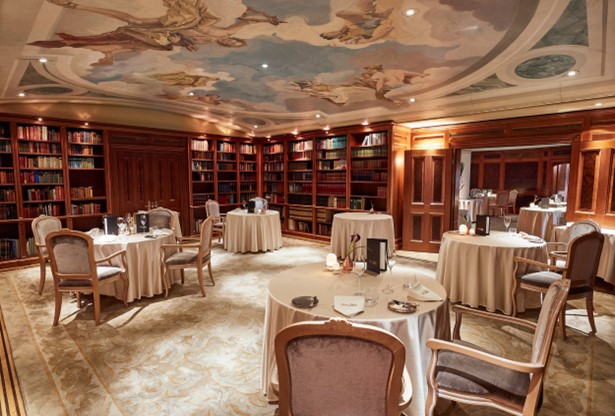
Lured into the library with its classic romantic atmosphere and fine wood-panelled walls, I examined the artwork and hand-painted crests amid ceiling-high bookshelves which gave way to a gorgeous, ethereal mural hovering above — a ceiling that seems to float above the room like a painted sky, its figures and scenes rendered with a delicacy that demands you stop and look, really look, before moving on. The library is the kind of room that makes you want to cancel your plans, pour a brandy, and lose yourself for hours.
The Hotel Adlon features 385 rooms and 78 suites with lavish accommodations, some with a dedicated 24/7 butler whose sole purpose is to ensure that every moment of your stay unfolds with the effortless precision that only the finest hotels can achieve. Guests find themselves immersed in refined, opulent interiors boasting the best marble sourced from the world's most prestigious quarries, fine woods that have been selected for their grain and character, and luxurious fabrics that invite touch — all complemented by impeccable five-star service that operates with the kind of quiet efficiency that makes the extraordinary feel effortless. Prestigious fine-dining with Chef Jonas Zörner at the two-time Michelin-starred Lorenz Adlon Esszimmer was booked for an event that night, as was I — a fortunate convergence that I would not let pass.
So I bookmarked what was sure to be an exquisite experience for later, and continued to the Brasserie Quarré for dinner by the light of the Gate at the terrace, where the Brandenburg Gate serves as the most magnificent dining companion imaginable. Watching the monument glow in the evening light as you savor impeccable French-inspired cuisine is an experience that belongs on every serious traveler's list — a moment where the city's history and its present-day pleasures merge into something unforgettable.
Historic Grandeur
More than a hotel, the Adlon Kempinski is a symbol of Berlin's past, present, and enduring sophistication, blending an evocative grandeur with modern luxury in its new era with a seamlessness that seems almost miraculous given the turbulence of the city's history. Its very history bestows a prestige that makes it one of a kind — not merely a place to stay but a living monument to the resilience and ambition of Berlin itself. Originally conceived in 1907 by modest wine merchant Lorenz Adlon during Europe's advent of the modern luxury hotel, Adlon garnered the support of Kaiser Wilhelm II himself to secure the primo location on Pariser Platz — a location so central, so symbolic, that it could only have been chosen by someone who understood that the greatest hotels are not merely built but placed, with the precision of a chess grandmaster positioning a queen.
Designed with neoclassical elegance and opulent amenities by Carl Gause and Robert Leibnitz, Hotel Adlon was one of the first hotels in the world to have running water and electricity functioning throughout its luxurious blueprint — a feat of engineering that was as revolutionary in its time as the hotel's design was beautiful. The Adlon was not merely keeping pace with the modern age; it was defining it, setting a standard for luxury that would echo through the decades.
The Adlon quickly became an alluring epicenter of high society, nobility, and prominent guests who were drawn to its magnetic combination of luxury, innovation, and the kind of effortless glamour that cannot be manufactured — it must be cultivated. Josephine Baker danced in its ballrooms, Enrico Caruso sang in its halls, Charlie Chaplin charmed its corridors, and Marlene Dietrich held court in its restaurants. FDR, Albert Einstein, and Thomas Edison all walked through its doors, alongside figures from the Weimar Republic who helped shape the cultural and political landscape of the twentieth century. The Hotel Adlon was not merely a witness to history; it was a participant in it, a stage upon which the drama of an era unfolded.
The Hotel Adlon was indeed the inspiration for the 1932 MGM film Grand Hotel, a testament to its place in the popular imagination as the very embodiment of luxury and intrigue. The Adlon's golden age is immortalized in other books and documentary films, each one adding another layer to the legend of a hotel that has always been more than a building — it has been a character in the story of Berlin itself.
During WWII, the hotel served as a hospital and American news headquarters, its grand ballrooms transformed into wards and its corridors echoing with the urgent footsteps of correspondents rather than the leisurely pace of socialites. After a series of tragic events during that period, the Adlon family struck a deal to build anew with the Kempinski hoteliers, a partnership that promised to carry the legacy forward into a new era. Alas, it was not until four decades later, in 1997, after the reunification of Germany — that momentous event that reshaped not just a city but a continent — that the world-class Hotel Adlon Kempinski opened its doors once more, reclaiming its place on Pariser Platz with the quiet dignity of a survivor.
Architects Patzschke, Klotz, and Parter were at the helm of the reincarnation, and their achievement is remarkable: the team replicated some of the original neoclassical grandeur and art nouveau whimsy with a fidelity that honors the past while creating spaces that feel entirely contemporary. The oversized marble columns, the library, the smoking room and cigar shop, and that famous Elephant Fountain, created by German sculptor August Gaul — all were faithfully recreated, each one a thread connecting the new Adlon to the old, each one a promise that some things are worth rebuilding.
Museum Island
The Museum Island complex, or Museumsinsel, is a UNESCO World Heritage Site of extraordinary significance, centrally located on the Spree River in the Mitte District, which serves as the major cultural hub of Berlin and one of the most important museum complexes in the world. It's a mere fifteen-minute stroll from Hotel Adlon along the storied, tree-lined Unter den Linden boulevard — a walk that is itself a journey through Berlin's history, past the Humboldt University, the State Opera, and the grand embassies that line this most ceremonial of avenues. The one-of-a-kind ensemble comprises five structures, each with its own unique architectural style and each housing collections that would be the crown jewel of any city's cultural offerings.
Designed by famed Prussian architects at the height of their creative powers, each structure reflected a deep and deliberate connection with the works it would house for public access — a philosophy that was revolutionary in its time and remains influential today. The idea manifested during the conceptually influential period between the Age of Enlightenment and 1930, when the notion that art should be accessible to all citizens, not merely the privileged few, was transforming the cultural landscape of Europe. The result is a complex that is not merely a collection of buildings but a cohesive vision of culture as a public good, rendered in stone and light.
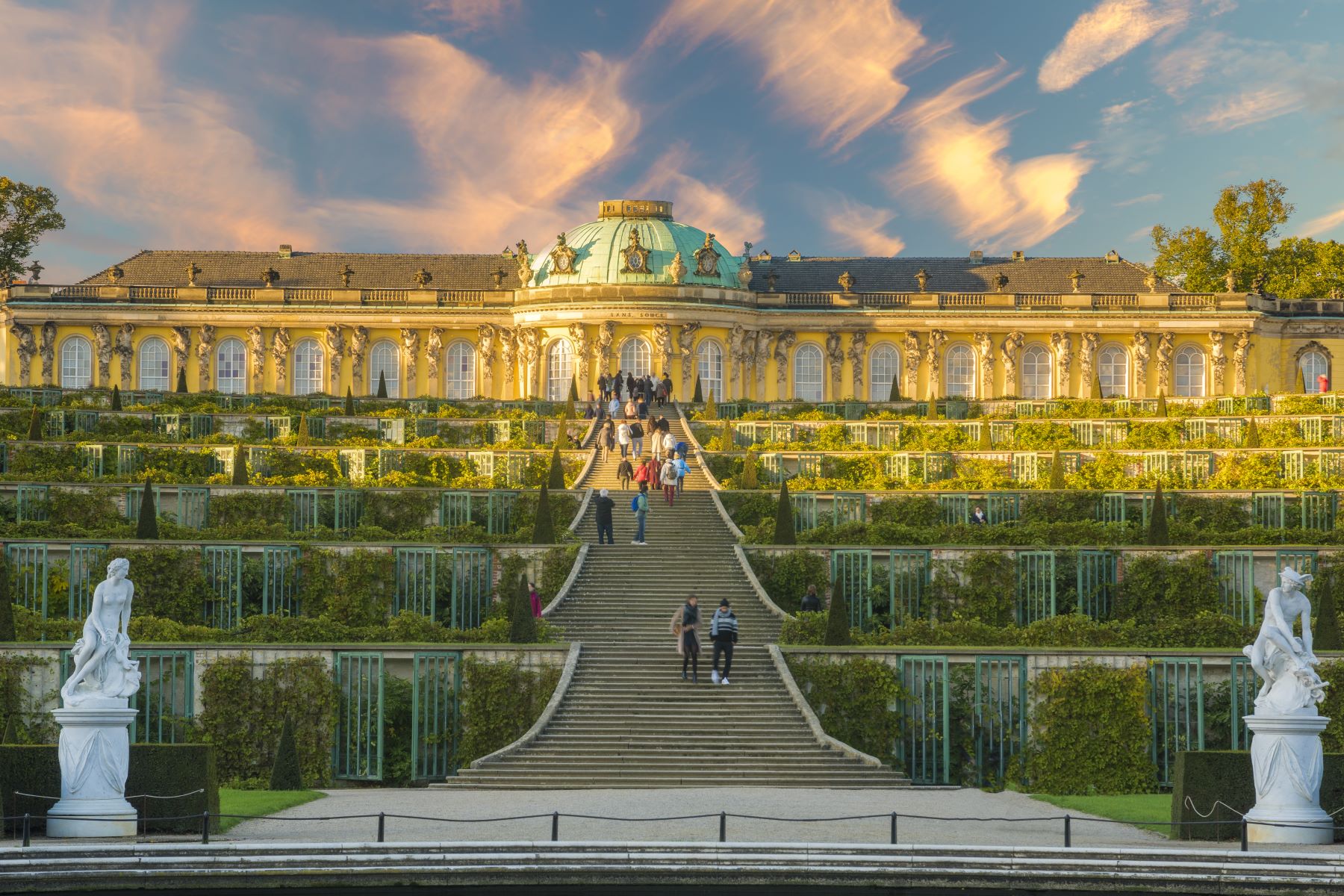
The beautifully ornate Berlin Cathedral, or Berliner Dom, revealed itself in the midday sun beside Friedrichsbrücke, a bustling footbridge that connects to Museum Island and serves as a threshold between the secular and the sacred, the everyday and the extraordinary. The views from the bridge are iconic — the kind of panorama that makes you stop mid-stride and reach for your camera, though no photograph can truly capture the way the light plays across the cathedral's green dome or the way the museums rise from the island like temples of a civilization that has made the pursuit of beauty its highest calling. On the other side, Neo-Classical columns reminiscent of an ancient acropolis welcomed me, exposing peeks of the regal architectural masterpieces en route to the entrance.
There is a particular thrill that comes from approaching Museum Island on foot — the way the modern city gradually gives way to something older, grander, more deliberate. The columns and porticoes and domes seem to rise from the water itself, as though the island were a gift from the Spree to the people of Berlin, a place where the accumulated wisdom and beauty of human civilization could be gathered and protected and shared.
Inside the classicist temple that is the Alte Nationalgalerie, I floated through its three levels in a state of increasing wonder, visiting Renoir and Cézanne before lingering at Lautrec with the kind of absorption that only truly great art can inspire. The long-term Scharf exhibits were surreal in the most literal sense — works that seem to exist in a space between the conscious and the unconscious, the familiar and the strange. The layout flowed with the natural grace of a well-composed symphony, guiding me effortlessly on my self-tour from one revelation to the next without ever feeling hurried or lost. I soon found myself entranced, standing before the Bust of Nefertiti, that iconic portrait whose serene beauty has captivated viewers for more than three millennia, before moving on to marvel within the serene, transportive spaces of the Neues Museum.
The Neues Museum is itself a masterwork of restoration, its scarred walls and modern interventions telling the story of destruction and rebirth that is so central to Berlin's identity. Walking through its halls, you are aware that you are moving through a building that has survived the worst of the twentieth century and emerged, not unchanged — that would be impossible — but transformed into something that honors both its past and its present with equal grace.
The Queen — Nefertiti — is the undeniable star of the show at the Neues Museum, her limestone visage drawing visitors from around the world who stand before her in reverent silence, but every room in this extraordinary building is an archeological immersion that rewards careful attention. Venus and Mercury hovered beneath the Neo-Baroque dome of the neighboring Bode Museum, which is a multi-cultural exploration of Roman, Byzantine, and Far-Eastern treasures that traces the movement of artistic ideas across continents and centuries. The Donatello and Bernini had me at hello — their sculptures possess a vitality that makes the marble seem to breathe, the bronze seem to move — before I finally ascended to the pillars and gems of antiquity at the Altes Museum, where the civilizations of Greece and Rome are displayed with a grandeur that befits their influence on the Western world.
Each museum on the island is a world unto itself, yet together they form a narrative that is greater than the sum of its parts — a story of human creativity and ambition that spans millennia and crosses every border that humankind has ever drawn. To visit Museum Island is to be reminded that art is not a luxury but a necessity, and that the impulse to create beauty is the most enduring of all human traits.
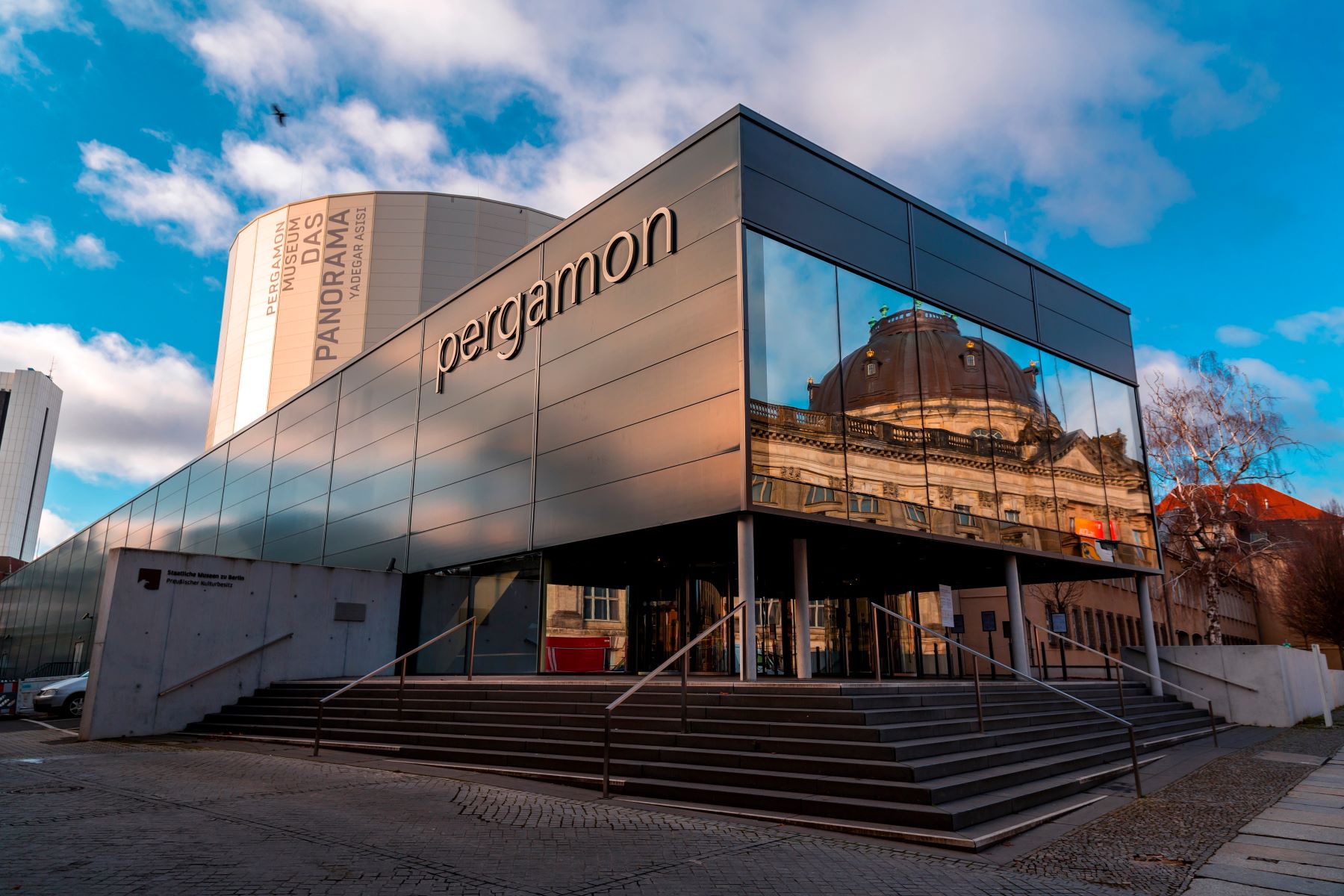
One afternoon, I toured the technologically enhanced temporary Pergamon Museum, which features an extraordinary exhibit that bathes sculptures in the vibrant colors the artists originally intended — a revelation that challenges everything most visitors think they know about classical art. The pure white marble we associate with antiquity was, in fact, painted in vivid hues that would seem garish to modern eyes, and seeing these works restored to their original polychrome splendor is a transformative experience that makes you reconsider the entire history of Western art. The actual Pergamon Museum, complete with its famous Altar of Zeus and Gate of Ishtar, is closed until 2027 for a comprehensive renovation, but the temporary exhibition offers more than adequate compensation.
Das Panorama by Yadegar Asisi brings the altar to life on a screen within a 360-degree theater at its temporary home, immersing visitors in atmospheric live action that is as educational as it is breathtaking. A climb atop the three levels in the center of the room lent a real-life glimpse at the daily rituals of an ancient metropolis in 129 AD — the sounds of the marketplace, the smoke of the temples, the teeming life of a city that existed two millennia ago rendered with a vividness that makes you feel as though you could step through the screen and into the past.
The three-day pass provides access to all five museums on the island, plus any special exhibitions currently on view — an extraordinary value that allows you to explore at your own pace without the pressure of a single-day ticket. It is available for purchase at Visit Berlin, the city's official tourism portal, and can be arranged in advance of your trip. Guided tours are readily available for those who prefer the insights of a knowledgeable docent, and they can be tailored to focus on specific collections or periods depending on your interests.
The distinctive Ladies in Red — the hotel's five-star concierge service identifiable by their elegant crimson attire — are stationed in Hotel Adlon Kempinski's lobby and are on hand to arrange tickets to museums and any other Berlin activities you might desire. Whether you wish to explore the East Side Gallery, secure a table at the city's most coveted restaurant, or arrange a private tour of a hidden architectural gem, the Ladies in Red operate with the kind of efficiency and discretion that has made the Adlon's concierge service legendary in a city that sets a very high bar for hospitality.
Reboot at the Adlon Spa
Courtest of Hotel Adlon
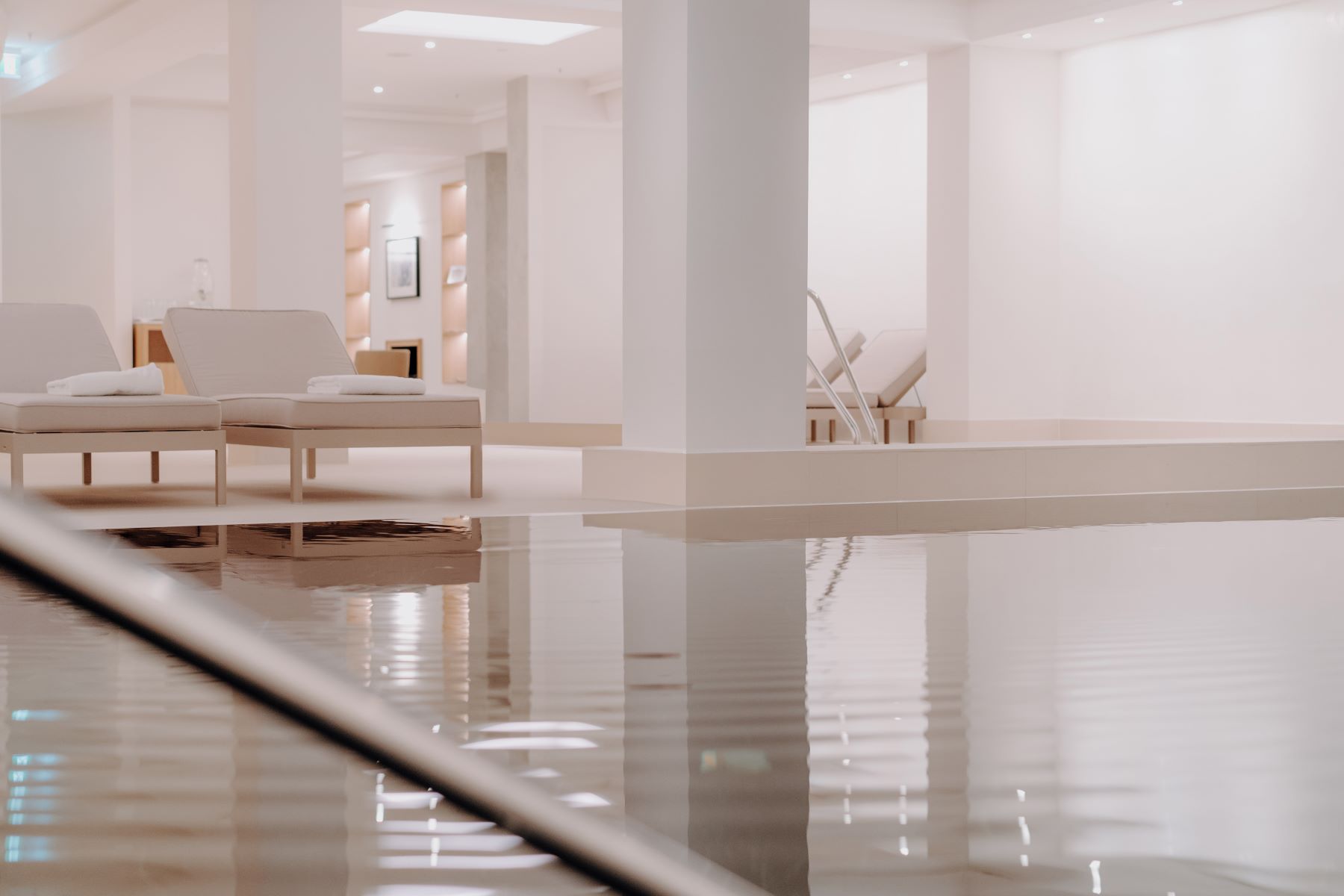
For guests who know the value of a time-out devoted to self-care — and after days spent absorbing the overwhelming cultural riches of Museum Island, such a time-out becomes not a luxury but a necessity — the Hotel Adlon Kempinski has a newly redesigned spa treatment area along with a sizable new pool and whirlpool, plus other wellness offerings housed within a new 9,000-square-foot contemporary wellness space that represents a significant investment in the art of relaxation. The spa is designed as a counterpoint to the grandeur of the public spaces above: where the lobby celebrates opulence, the spa celebrates calm, offering a sanctuary of stillness and restoration that feels worlds away from the bustling city outside.
The new wellness space is a testament to the hotel's understanding that modern luxury travelers seek not just beautiful rooms and fine dining but comprehensive wellbeing — a place to restore the body and quiet the mind after the sensory intensity that Berlin inevitably delivers. Whether you spend an hour or an entire afternoon, the spa offers the kind of deep, restorative relaxation that prepares you for another day of exploration in one of Europe's most dynamic cities.
The updated design replaces the former Roman-style grotto spa with a bright, modern aesthetic defined by natural materials, clean lines, and lighting that seems to have been calibrated to induce a state of calm the moment you step through the door. The transformation is striking: where the former spa was dark and atmospheric, the new space is luminous and airy, creating an environment that feels simultaneously expansive and intimate. A redesigned pool bar menu offers healthy options and classic dishes, along with an array of beverages including cocktails crafted with the same attention to detail that defines the hotel's dining program above.
The decision to move away from the Roman grotto aesthetic was a bold one — it was, after all, the hotel's signature spa experience for many years — but the result justifies the vision entirely. The new design feels more aligned with contemporary wellness sensibilities, offering a space that is both restorative and uplifting, a place where the light itself seems to have healing properties.
Jagdfeld created the spacious facility in collaboration with the Kempinski Hotel, providing a relaxation fireplace lounge beside the expanded wellness offerings that include a Finnish sauna, a soft sauna, and a steam room with an optional cold-plunge, and an aromatherapy mist to round out a hydro-circuit experience that is as comprehensive as any in Europe. The fireplace lounge is a particularly inspired touch — a space where you can sink into a comfortable chair beside the flames and let the warmth penetrate muscles that have been walking museum corridors for hours, a glass of herbal tea in hand and nothing on the agenda but the simple pleasure of being still.
The hydro-circuit experience is designed to be followed in sequence, each treatment preparing the body for the next: the heat of the sauna opening the pores, the steam of the steam room penetrating deeply, the shock of the cold-plunge invigorating the circulation, and the gentle embrace of the aromatherapy mist restoring equilibrium. It is a ritual that has been practiced in various forms for millennia, and the Adlon's version executes it with the precision and elegance that define the property.
Upstairs, just beyond the oasis of calm that is the spa, guests can also access a 24-hour state-of-the-art gym equipped by Technogym, ensuring that even the most dedicated fitness enthusiasts need not compromise their routines while traveling. The gym features the latest in cardiovascular and strength-training equipment, all arranged in a space that is bright, well-ventilated, and sufficiently private that you can focus on your workout without feeling observed.
The 24-hour access is a thoughtful touch that reflects the hotel's understanding that its guests operate on many different schedules — the early-morning exerciser and the late-night traveler alike will find the gym ready and waiting, a quiet space where the only competition is with yourself and the only goal is the satisfaction of knowing that you have maintained your discipline even while surrounded by the many temptations that Berlin offers. Personal training sessions can also be arranged through the concierge, allowing guests to maintain their wellness routines with expert guidance even far from home.
An array of treatments is available by appointment only, each one delivered by skilled therapists who understand that the art of spa treatment lies not just in technique but in the ability to create an atmosphere of trust and relaxation. From deep-tissue massages that target the specific tensions accumulated during travel to restorative facials that counteract the effects of airplane cabin air and urban pollution, the treatment menu is designed to address the real needs of the modern luxury traveler.
For hours of operation and to schedule appointments, inquire within — the spa's staff will be happy to recommend treatments tailored to your specific needs and ensure that your wellness experience at the Adlon is as personalized and restorative as possible. The spa also offers specialized wellness programs that combine multiple treatments into curated sequences designed to address specific concerns — from jet lag recovery to stress reduction — ensuring that every guest departs feeling not merely refreshed but genuinely renewed.
Folio · Folio · 28°07'48"S 35°24'35"E · Bronze Tier
At its best, a luxury hotel experience transcends the mere provision of a comfortable bed and attentive service; it encompasses thoughtful elements of culture, opulence, design, and exclusivity comparable to the world's…
— Club ledger, May 5, 2026, archive no. 8805