The Archive Folio
- June 29, 2026
- ByGlenn Harris
There are two types of holiday in Italy, and understanding the difference between them is the first step toward understanding why some travelers return from the same country with fundamentally different experiences—not because of where they went, but because of how they were permitted to go. This distinction, subtle as it may seem, separates the merely pleasant vacation from the genuinely transformative journey, and it is a distinction that has everything to do with intention, pace, and the quality of access one is granted to the inner life of a place. Italy, more than perhaps any other country, rewards this kind of differentiated approach, because Italy is not one experience but many—layered, contradictory, and endlessly deep, a country that reveals itself only to those who approach it with the right combination of curiosity and patience. The surface is dazzling enough to satisfy most visitors, but those who descend beneath it discover an entirely different country waiting.
One is a tourist's holiday. You hit the major landmarks with the efficiency of a military campaign. You do what everyone else is doing, following the same well-worn paths that millions have walked before you, queueing for the same photographs from the same angles, eating at the same restaurants recommended by the same algorithms. You join the travel horde, move through the itinerary, take the photographs, leave. It is not a bad thing, necessarily—it is simply what most people do, and for many people it is enough. But it leaves untouched the vast majority of what Italy actually has to offer to those willing to venture beyond the surface. The tourist's Italy is a beautiful surface, certainly—all marble façades and Renaissance frescoes and plates of pasta arranged for maximum visual appeal—but it is a surface nonetheless, and behind it lies an entire country of extraordinary depth that remains invisible to those who move too quickly or look only where they are told to look.
The other is a traveler's holiday. You explore rather than simply visit. You understand what a destination actually offers versus something manufactured for tourist consumption. You discover what is worth knowing and why—peeling back the layers of a place until you reach something genuine, something that cannot be replicated or reduced to a social media post, something that changes the way you think about the world and your place within it. The traveler's Italy is slower, quieter, and infinitely more rewarding. It is found not in the checklist of must-see sights but in the unexpected conversation with the shopkeeper, the unmarked trattoria that serves the best meal of your life, the hilltop village that no guidebook mentions because nothing there has been packaged for visitor consumption. It requires a different kind of travel company to access—one that knows the difference between showing you Italy and letting you inside it, between performing hospitality and extending genuine welcome.
I found this out on a recent trip arranged by Massari Travel, a discovery that fundamentally altered my understanding of what a travel company can accomplish when it refuses to settle for the merely adequate and commits instead to the genuinely extraordinary. Massari Travel does not operate in the manner of conventional luxury tour operators, who measure success by the exclusivity of their hotel partnerships and the seamlessness of their logistics. Their ambition is altogether different and more radical: to create experiences so authentic and so deeply connected to the real life of Italy that they cannot be distinguished from the kind of access that only a lifelong local resident could provide. It is an approach born of nearly sixty years of patient cultivation, and its results are, quite simply, unlike anything else available in Italian travel today—a claim I make not from promotional enthusiasm but from direct, personal experience.
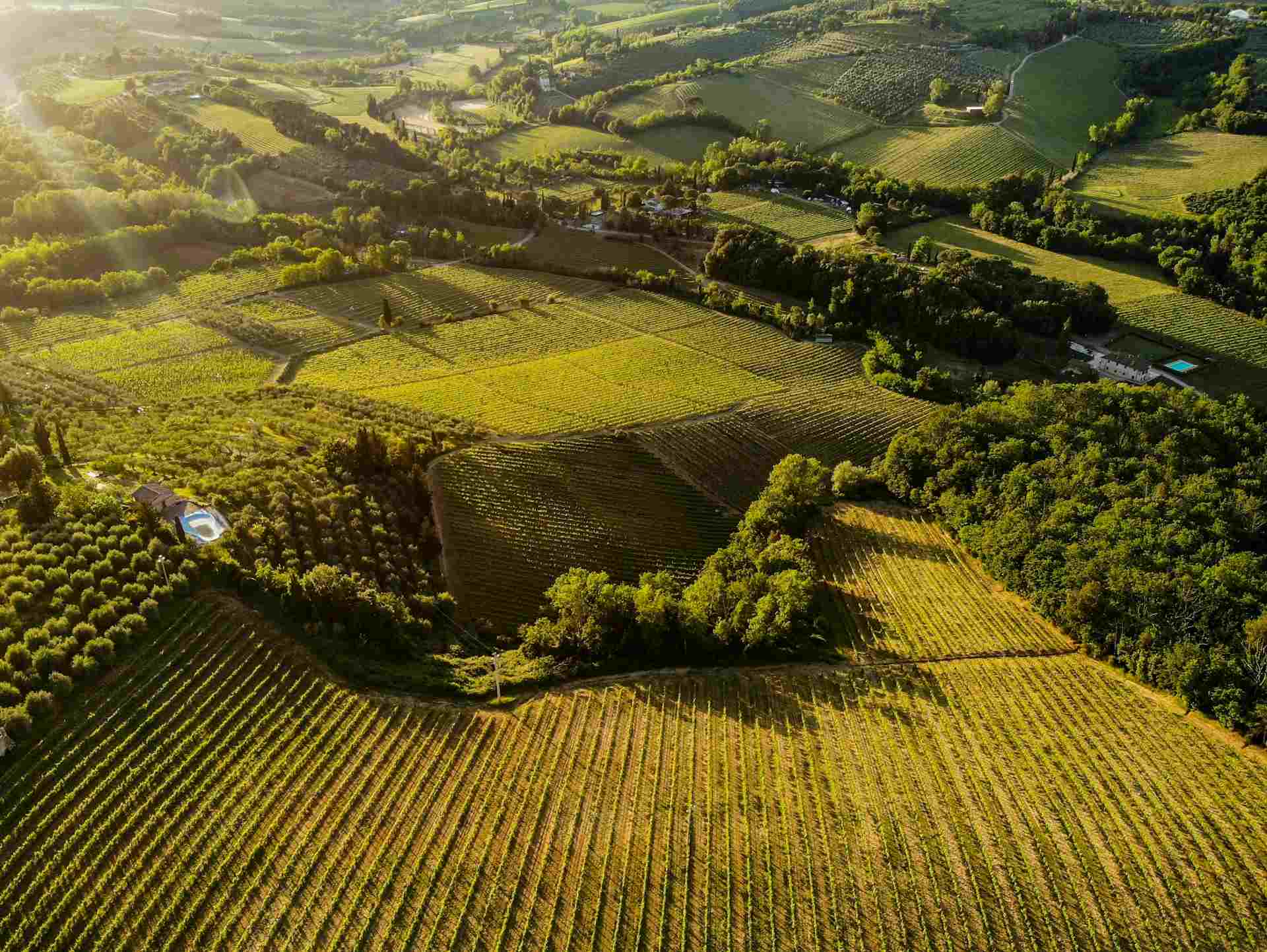
Lush vineyards stretch across rolling hills under golden sunlight, showcasing the beauty of rural landscapes.
The road deteriorated into gravel and the world narrowed to the essentials: sky, earth, and the ancient olive trees that thickened around us, their silver-green leaves catching the afternoon light in ways that made the landscape feel intentional, designed—as if some divine hand had arranged each tree precisely where it would catch the sun to greatest effect. But it wasn't designed. It was just what happened when you left the main roads behind and followed someone who knew where the real Italy lived—not the Italy of guidebooks and tourist itineraries, but the Italy that has existed quietly for centuries, waiting for those patient enough to find it. The transition from asphalt to gravel was, I would come to understand, a kind of threshold—the point at which the curated, visitor-ready version of Tuscany gave way to something older and more authentic, a landscape shaped not by the demands of tourism but by the slow, patient logic of agriculture and the seasons that govern it.
The vineyard came into view suddenly, thousands of vines folding across the Orcia Valley floor and climbing the opposite slope until they vanished into haze at the base of Monte Amiata like a curtain drawn across the edge of the world. A stone house sat above it all, pale and weathered by decades of the Sienese sun and wind, the kind of structure that tells you more about a place in a single glance than any guidebook could convey in a hundred pages. No signs. No tour bus parking. No visible business at all—just the quiet certainty of a place that has never needed to announce itself because those who need to find it always do. This is the Val d'Orcia at its most essential—the landscape that inspired Renaissance painters and continues to inspire anyone who takes the time to look, not as a tourist attraction but as a living, working agricultural landscape where beauty is not the product but the byproduct of generations of careful stewardship.
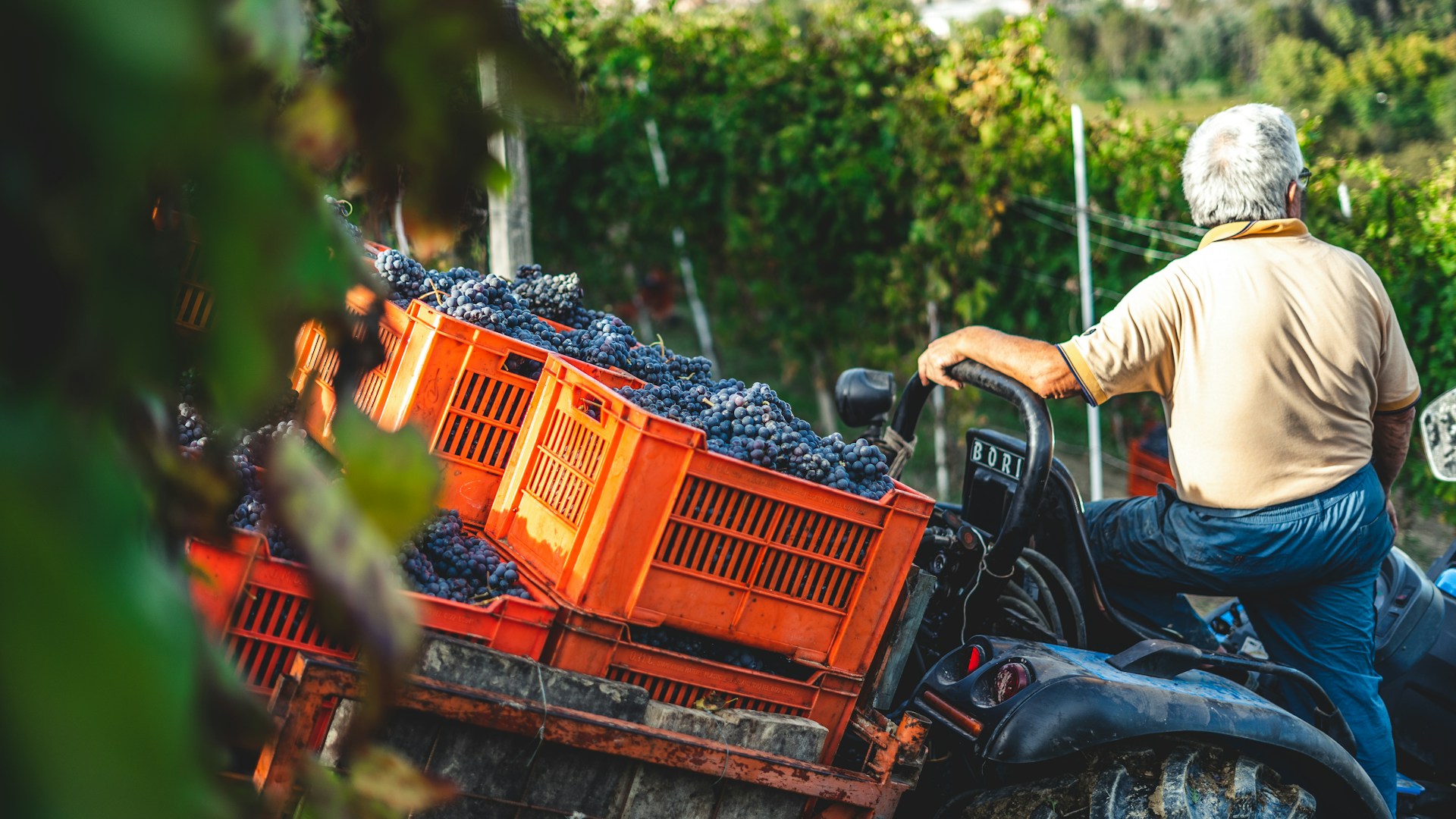
An older man sits on a tractor, surrounded by orange crates filled with freshly harvested grapes in a vineyard.
The man was waiting outside the cellar, sleeves rolled past his elbows in the manner of someone for whom work is not a concept but a daily practice, watching the valley with the steady attention of someone who has been reading its moods for a lifetime. He turned when we pulled up, his expression revealing neither surprise nor obligation—just the quiet recognition of an expected guest. No ceremony. No prepared speech. Just a handshake and a direction: "Come inside." In that simple invitation lay an entire philosophy of hospitality that has nothing to do with the service industry and everything to do with the ancient Italian tradition of welcoming the stranger as a friend—a tradition that predates tourism itself and survives only in places like this, where the rhythms of life are still set by the land and the seasons rather than by the expectations of visitors or the demands of the market.
The temperature dropped the moment we passed the threshold, a physical transition that felt like crossing from one world into another—from the sun-baked exterior of Tuscan summer into the cool, perpetual twilight of a working cellar. The air was cool and smelled of damp stone and something sweetly fermented that clung to the back of my throat with an insistency that was almost tactile. The cellar stretched deeper than the building suggested possible, rows of enormous oak botti receding into shadow like the ribcage of some ancient creature, each barrel holding a vintage that told the story of a particular year, a particular harvest, a particular set of decisions made by the man who now stood beside me. This was not a cellar prepared for visitors—there were no tasting notes, no curated lighting, no gift shop at the end. This was a working cellar, and the wine we would taste here was the same wine that the family drank and the same wine that they sold, unmediated by the marketing apparatus that surrounds most modern wine experiences.
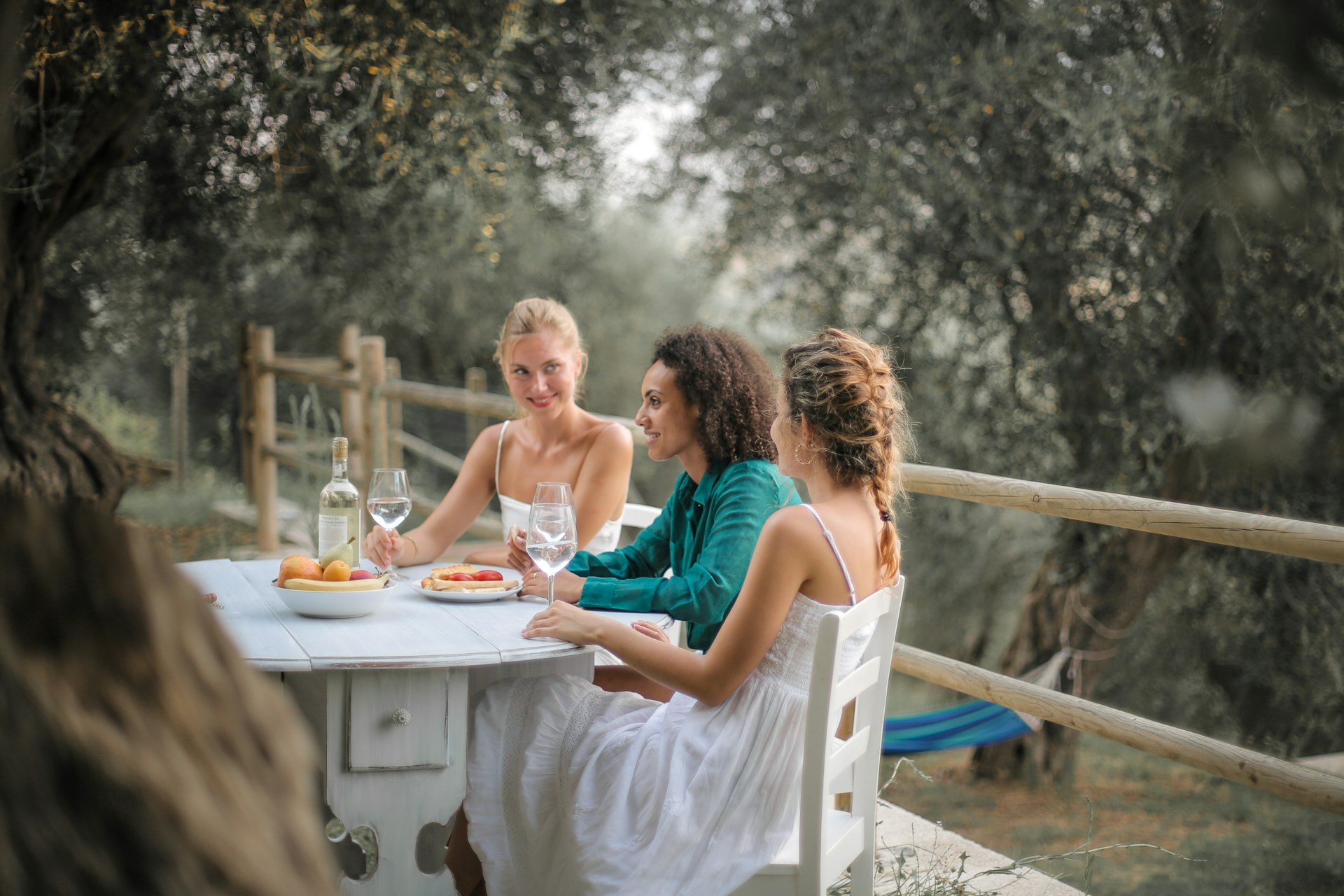
Three women enjoy a meal and glasses of wine at a table surrounded by olive trees, creating a serene atmosphere.
He didn't wait for questions—he knew that the most profound understanding comes not from explanation but from experience. He pulled a glass thief from the wall with the practiced ease of someone who has performed this gesture thousands of times, inserted it into one of the barrels at eye level, and drew out young Brunello, still darkly red and still moving with the viscosity of something alive—something that had not yet settled into its final character but was still in the process of becoming. He poured it into my glass without comment and leaned against the cask, watching my reaction with the quiet attention of an artist observing how their work is received. The wine was raw and vital, nothing like the polished Brunello that reaches the international market—this was the wine in its truest state, still evolving, still expressing the particular character of the vintage and the land with an honesty that bottling and aging inevitably soften.
"My father taught me when the grapes were ready," he said, his voice carrying the weight of generations. "Not from machines. From walking." In that single sentence lay an entire worldview—a rejection of the modern obsession with measurement and optimization in favor of something older and more reliable: the accumulated wisdom of a body that has spent a lifetime moving through the same landscape, feeling the same soil, tasting the same fruit at every stage of its development. This is knowledge that cannot be transmitted through data or replicated through technology. It is embodied knowledge, the kind that lives in the fingertips and the palate and the instinct, passed from one generation to the next through the simple act of shared presence—a father walking his rows, a son following behind, learning to read the language of the land not through instruction but through immersion in its daily practice and its quiet, unhurried rhythms.
"As a boy I followed him during harvest. Watched him crush grapes between his fingers, taste them, study the seeds with the concentration of a jeweler examining a diamond. Ripeness wasn't a number on a refractometer. It was texture. Acidity. Patience." He gestured at the barrel with a movement that encompassed not just the wine but the entire tradition it represented. "Wine is the same. You cannot rush it. You have to know when it's speaking properly." It was, I realized, not a lesson about wine at all—it was a lesson about everything that matters: attention, patience, and the willingness to let things develop at their own pace rather than imposing a schedule upon them. This philosophy, so deeply Italian in its respect for process over product, is precisely what distinguishes the great estates from the merely commercial ones, and it is precisely what Massari Travel understands: that the most valuable experiences in Italy are those that have been allowed to ripen at their own pace.
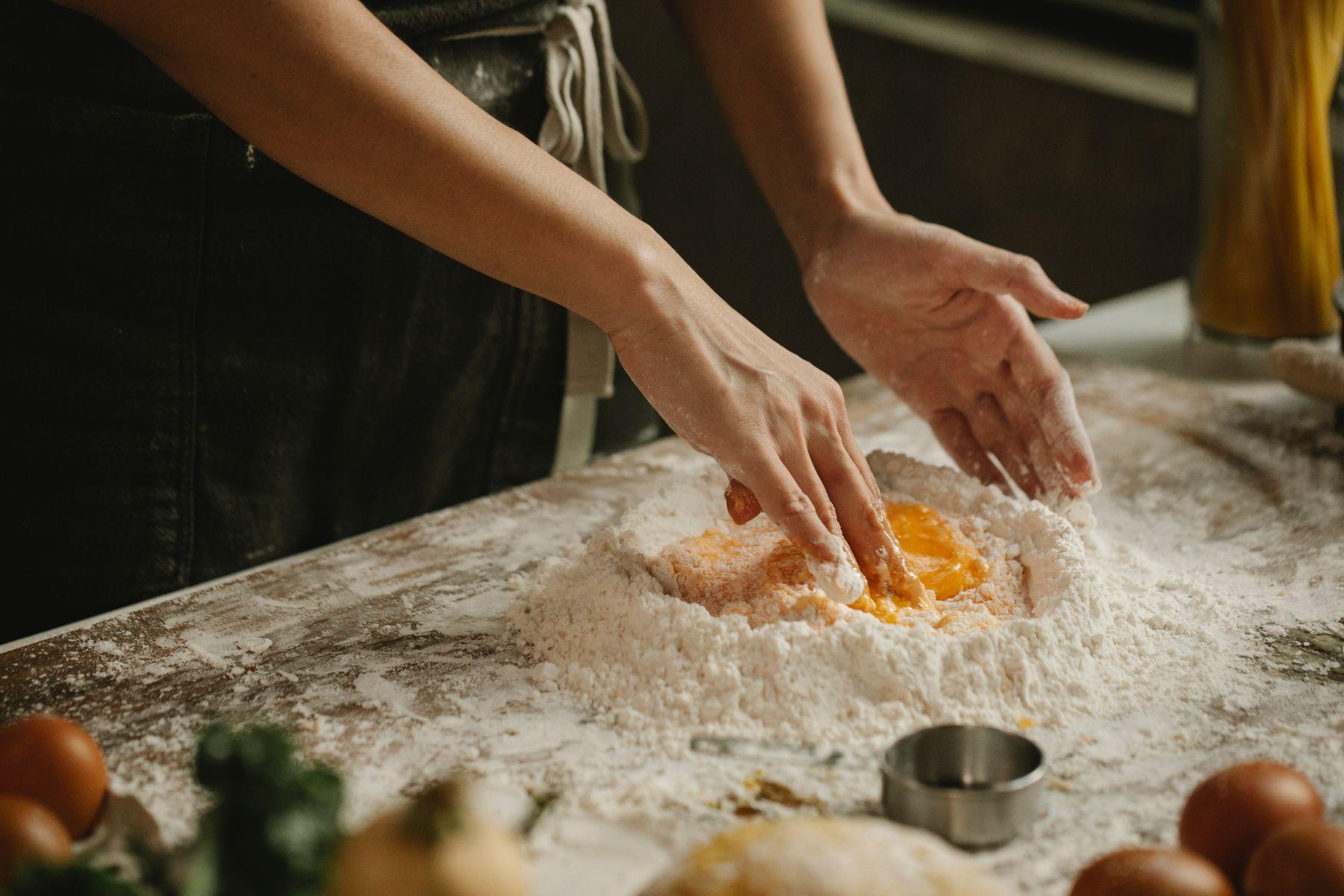
Hands mixing flour and egg yolks on a wooden surface, with fresh ingredients and kitchen tools in the background.
This is where most travel companies would start selling you the story—packaging it into a marketable narrative, polishing the rough edges until it became another product in the luxury travel catalog. Massari doesn't work that way. They understand that the moment you try to commodify an experience like this, you destroy precisely what makes it valuable: its authenticity, its intimacy, its unrepeatable quality. The visit to the cellar was not arranged as a performance for a paying guest; it was arranged as a genuine introduction between two people who share a love of wine and the land that produces it. The difference is everything. One produces a pleasant afternoon; the other produces an understanding that stays with you for life, an insight into the relationship between craft, place, and tradition that no amount of luxury packaging can replicate and no amount of money can purchase—and it is precisely this difference that Massari has built its entire reputation upon.
They don't build trips around itineraries or checkboxes, and they don't even really build them around destinations in the conventional sense. What they've spent nearly sixty years learning to arrange is something harder to manufacture and impossible to replicate: genuine entry into the private life of the places they know—not access for tourists, who are tolerated and accommodated, but access for people who actually want to understand something, who are willing to slow down enough to receive what a place has to offer rather than simply consuming it and moving on. It is a distinction that sounds subtle until you experience it, and then it becomes the only distinction that matters. This approach requires relationships built over decades, a network of trust that cannot be purchased or shortcut, and an unwavering commitment to quality over scale—qualities that Massari has cultivated since its founding and that explain why their clients return year after year, often for decades.
The owner led me deeper into the cellar, past working inventory where the current vintage slept in its oak cradles, toward the rear wall where older vintages collected dust against aged stone—the library of a lifetime's work. He moved without fanfare, running his hand along the bottles with the tenderness of someone greeting old friends, until he found the one he was looking for. The label was faded, its text barely legible in the dim light. He pulled it down and opened it with a corkscrew that had clearly opened thousands of bottles before this one. There was no ceremony in the gesture, no theatrical presentation—just the quiet competence of a man opening a bottle that meant something to him, a bottle he had been waiting for the right moment to share. And in that absence of performance lay its own kind of eloquence, the eloquence of genuine hospitality as opposed to professional service.
"My daughter's birth year," he said simply, and in those three words was contained everything you needed to know about the relationship between this man, his land, and his craft—a relationship so intimate that the milestones of his personal life and the vintages of his professional life are woven together into a single, inseparable narrative. This is the reality of the small, family-owned estate in Italy: there is no separation between the personal and the professional, between the life and the work. Every vintage is a year of the family's history, every bottle a chapter in an autobiography written in grape and soil and weather. To drink this wine was not merely to taste a product; it was to receive a confidence, to be admitted briefly into the private chronicle of a family's experience of their land and their life upon it—the kind of access that no conventional wine tour can provide.
We tasted in silence, and the silence was not empty but full—the kind of silence that occurs between people who understand that some experiences are too profound for commentary. He talked about difficult harvests, about a summer years ago that nearly destroyed everything he had built, about the decades before Brunello became fashionable enough for investors and wine magazines, when this estate was simply a place where his family worked the land because that was what you did—because the land was there and you were there and the work needed doing. The kind of details that don't make guidebooks because they're not picturesque. They're just true, and in their truth lies a depth of understanding that no amount of curated tourist access could ever provide. This is what Massari delivers: not the highlight reel of Italian wine culture but its full, complicated, deeply human reality, with all its struggles and triumphs and quiet satisfactions intact.
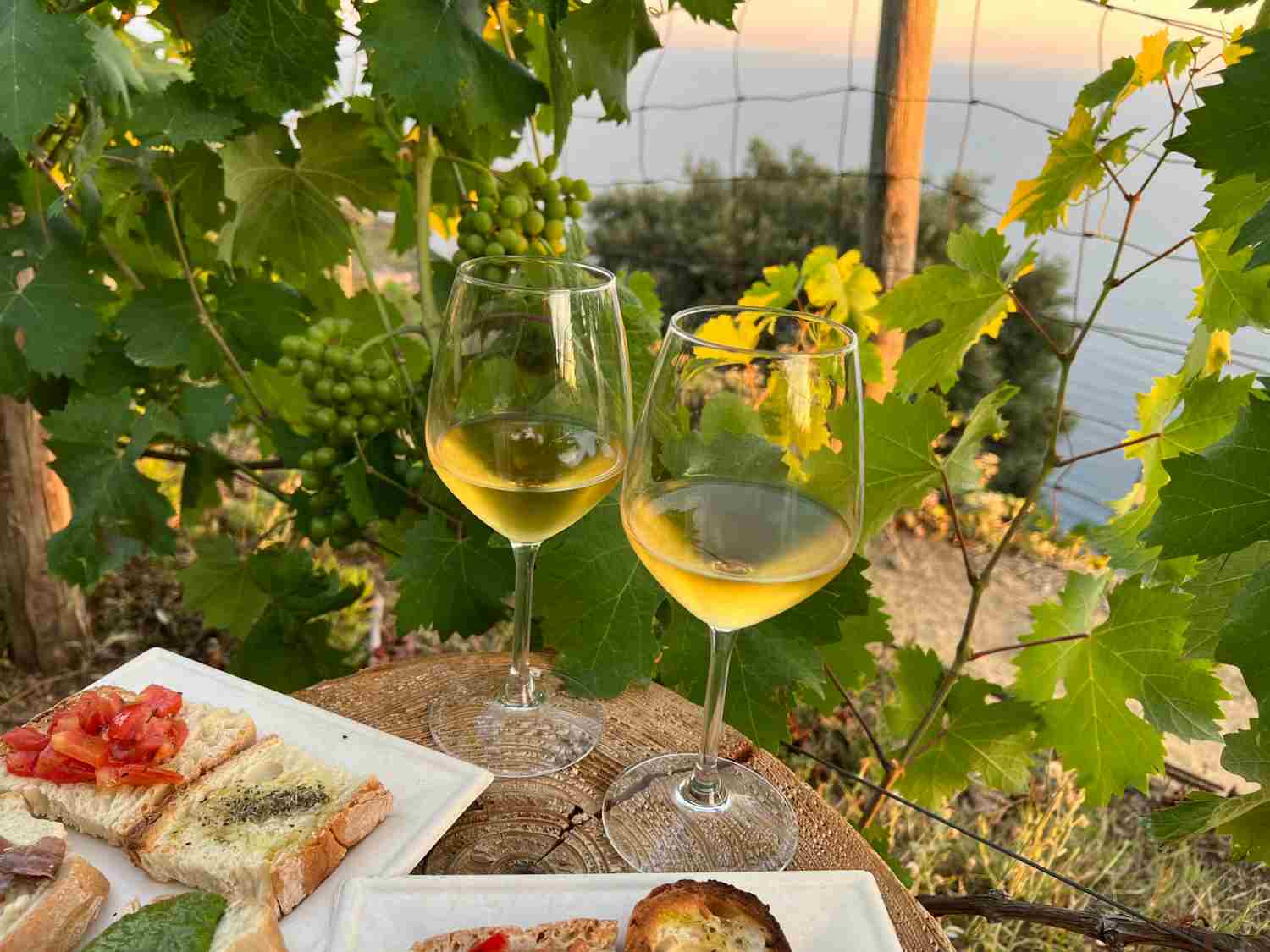
Two wine glasses on a wooden surface surrounded by grapevines, with plates of appetizers in the foreground and a scenic view behind.
By the time we climbed back outside, the light had changed in the way that only Tuscan light can change—shifting from the harsh clarity of midday to the warm, golden softness that painters have been trying to capture since the Renaissance. The gravel shifted underfoot as we walked through the Sangiovese rows, and the hills had gone quiet in that particular way Tuscan hills do when afternoon tips toward evening and the world seems to draw a breath before nightfall. I understood then why Massari had arranged for me to end the day here rather than begin it. Timing matters when you're not performing access—it matters when you're actually inside something, when the goal is not to see a place but to feel it, to let it work on you at the pace it requires rather than the pace your schedule demands. The golden hour is when Tuscany speaks most clearly, and Massari knows this with the certainty of long experience.
Across Italy, this is how Massari operates—with a consistency of vision and quality that can only come from decades of patient cultivation. Medieval hill towns in Umbria where the local historian reveals connections between architecture and politics that no guidebook could ever articulate. Family estates in Puglia where olive oil production hasn't changed in a century because there has never been a reason to change something that already works perfectly. Private palazzi in cities most travelers skip entirely, where the current generation of the family welcomes you as a guest in their home rather than a client in their business. Wine regions so remote that the rhythm of daily life is still set by seasons and by what the earth produces when—and where the most extraordinary experiences are available only to those who arrive with the right introduction. The common thread is authenticity—not the curated, marketable kind, but the real thing, which is always unannounced and often unphotographable.
What they've figured out that larger operators haven't—and perhaps can't, given the structural incentives of their business models—is this: the most expensive, most desirable form of luxury isn't marble or infinity pools or Instagram-ready aperitivos with golden hour lighting. It's depth. It's time. It's the understanding that the best travel isn't performative—it's intimate. It happens not in the grand public moments that you can photograph and share, but in the private, unrepeatable moments that exist only between you and the place and the people who have given their lives to understanding it. Massari has built an entire business around this insight, and the result is something that no amount of money alone can purchase: genuine access to the interior life of Italy, the country as it actually exists rather than as it has been packaged for tourist consumption, with all its complications and contradictions and extraordinary, enduring beauty intact and undiminished.
Their family program, built around a character called Lucio the Little Bear, works the same way—because in a country where the culture is experienced through all the senses and at every pace, children cannot be treated as an afterthought. Children move through Italy differently than adults do, which means adults have to adjust their pace to match—a forced slowing that, paradoxically, often produces the most meaningful experiences of an entire trip. Multigenerational travel usually fails because someone gets watered down—the adults sacrifice what they want, or the children are dragged through experiences they can't appreciate. Massari designs for everyone or designs for nobody, creating itineraries where each generation discovers something that belongs uniquely to them while sharing experiences that become family lore. It is a philosophy that recognizes a truth most travel companies overlook: that the best family trips are not compromises but compositions, each member's experience enriching rather than diminishing the others.
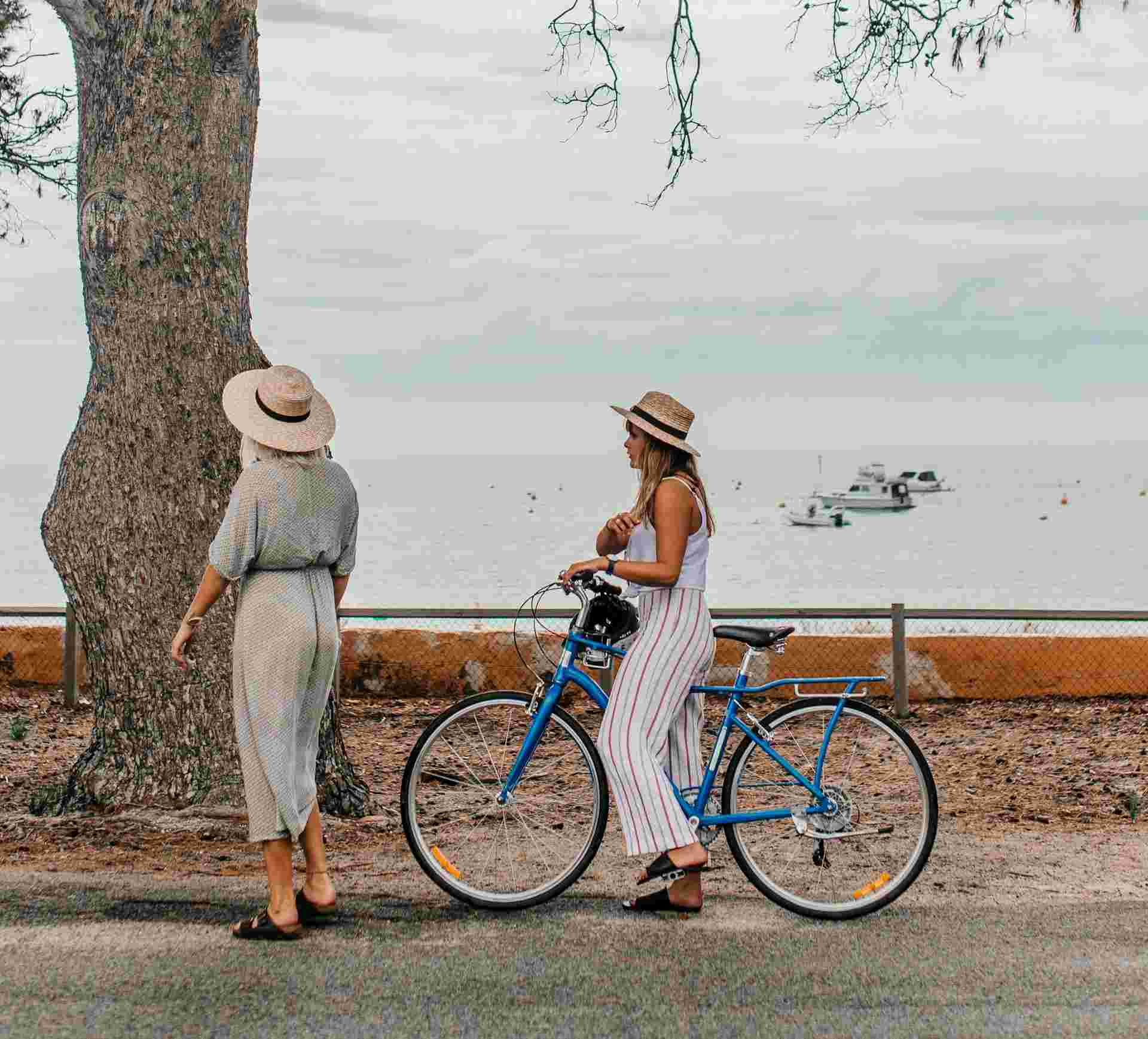
Two women in hats stroll along a seaside path, one holding a bike, enjoying the coastal scenery.
The real thing Massari Travel has learned to sell isn't logistics, though the logistics are flawless—every transfer seamless, every reservation confirmed, every contingency anticipated. It's not even access, though the access is remarkable and extends into corners of Italian life that no amount of money alone could unlock. It's the understanding that Italy's most valuable export is proximity to people who actually know it from inside—the winemaker who inherited ripeness from his father, the artisan who hasn't changed his methods because there's never been a reason to, the contessa who opens her private rooms for a select few because she genuinely loves sharing the beauty she has inherited, not because she needs the revenue. These relationships are the fruit of nearly sixty years of cultivation, and they cannot be replicated by any competitor, however well-funded or ambitious, because they are not commercial relationships—they are personal ones, built on trust and affection and shared history.
Getting you into that cellar isn't a perk. It's the entire point—the difference between a trip and a journey, between seeing Italy and understanding it, between ticking off a destination and being transformed by it. Everything Massari does—every carefully calibrated itinerary, every perfectly timed arrival, every introduction that opens a door no tourist could find—is in service of that single, radical idea: that travel at its finest is not about consumption but about connection, and that the most valuable thing you can bring home from Italy is not a photograph or a souvenir but a deeper understanding of what it means to live well. In a travel industry increasingly dominated by scale, standardization, and the pursuit of margins, Massari's commitment to this idea is not merely admirable—it is essential, a reminder that the best travel has always been, at its heart, a human exchange rather than a commercial transaction, an encounter between people rather than a purchase of experiences.
Folio · Ledger · 66°57'36"N 96°22'12"E · Silver Tier
There are two types of holiday in Italy, and understanding the difference between them is the first step toward understanding why some travelers return from the same country with fundamentally different experiences—not…
— Club ledger, June 29, 2026, archive no. 9144