The Archive Folio
- May 4, 2026
- ByKeri Bridgwater
A new chapter in luxury rail travel is set to unfold in England this summer as the iconic British Pullman unveils an extraordinary new private dining and events carriage conceived by filmmaker Baz Luhrmann and Oscar-winning costume and production designer Catherine Martin — a collaboration that brings together two of the most visionary creative minds working in any medium today. The announcement alone is enough to set the world of luxury travel abuzz, for the British Pullman occupies a singular place in the annals of elegant rail travel: a moving monument to the golden age of the locomotive, when the journey was as important as the destination and the dining car was a stage for the grandest of occasions.
The new carriage promises to push the British Pullman into more immersive territory than ever before, blending the glamour of classic rail travel with the kind of rich storytelling usually reserved for film and theater — a fusion that feels not merely innovative but inevitable, given the creative pedigree of its designers. For those who have long believed that the most memorable travel experiences are those that engage the imagination as fully as the senses, the arrival of this new carriage represents something genuinely exciting: a reimagining of what luxury rail travel can be.
Created for Belmond, the luxury travel brand whose portfolio includes some of the world's most celebrated hotels, trains, and river cruises, the lavish new carriage pushes the British Pullman into more immersive territory, blending the glamour of classic rail travel with the kind of rich storytelling usually reserved for film and theater. Newly launched aboard the historic train, Celia is designed for intimate celebrations, private dinners, and bespoke events for up to 12 people, offering a level of exclusivity that is increasingly rare in a world where luxury is often mass-produced. The carriage includes its own lounge, bar, and kitchen, along with a dedicated guest experience curator — a newly created role focused entirely on tailoring each journey for Celia passengers — ensuring that every moment of the experience is attended to with the kind of personalized care that distinguishes the truly exceptional from the merely excellent.
But its cinematic narrative may be what truly distinguishes Celia from every other luxury carriage that has ever traversed the British countryside. This is not simply a beautifully appointed space; it is a world unto itself, a story that unfolds as the landscape rolls by, each chapter revealed with the precision and drama of a masterfully directed film. The result is an experience that engages not just the palate and the eye but the imagination — a rare achievement in any context, and a remarkable one aboard a moving train.
Inside Baz Luhrmann's Theatrical Vision on Rails
Baz Luhrmann has spent a career transforming the familiar into the extraordinary — reinventing Shakespeare for a new generation, reimagining the Hollywood musical for a postmodern audience, and bringing the decadent world of the Jazz Age to cinematic life with a visual virtuosity that borders on the operatic. Now, the Australian auteur has turned his formidable imagination to the world of luxury rail travel, creating an experience that is less a train journey than a rolling theatrical production, where every carriage is a stage, every meal is a scene, and every mile of track carries passengers deeper into a story that unfolds with the deliberate pacing and visual splendor of one of Luhrmann's own films.
The result is a travel experience that defies easy categorization — part immersive theater, part design installation, and part fever dream of gilded romance, all set against the ever-changing backdrop of the landscape beyond the window. Luhrmann's genius lies in his ability to make grandeur feel intimate, to render spectacle personal, and to create environments that are so richly detailed and emotionally resonant that they cease to feel like design and begin to feel like destiny.
Beyond simply creating a beautifully appointed train car, Luhrmann and Martin have crafted an entirely fictional world centered on a mysterious 1930s West End actress named Celia — a character whose biography is as richly detailed as any protagonist in Luhrmann's filmography. According to the story, she was awarded her own Pullman carriage following a triumphant performance as Titania in Shakespeare's A Midsummer Night's Dream, a reward befitting a star of her luminous talent and impeccable taste. Every detail in the carriage draws from this imagined history, transforming the journey into something closer to a moving stage set than traditional luxury transport — a space where fiction and reality blur with the kind of effortless sophistication that only true artists can achieve.
The genius of this approach lies in its totality: the story is not merely decorative but structural, informing every choice from the color palette to the textiles, from the music to the menu. Guests are not simply passengers in a beautiful carriage; they are characters in a story that unfolds with each passing mile, invited to lose themselves in a world of theatrical glamour and artistic imagination that makes the journey itself the destination.
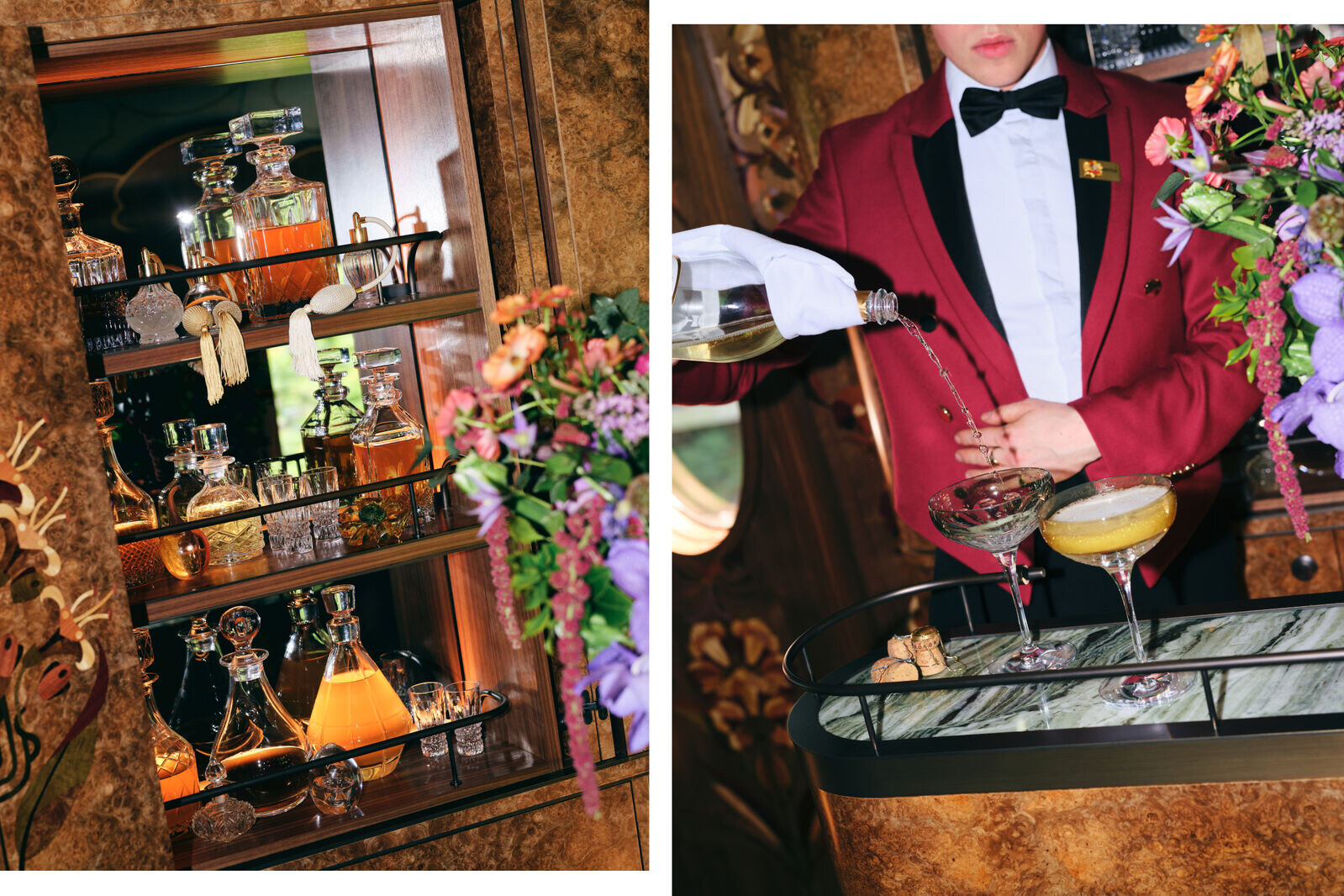
Celia's dedicated cocktail bar
The interiors are richly layered with references to English pastoral landscapes, Shakespearean symbolism, and the opulent visual language synonymous with Luhrmann's iconic visual feast films like "Moulin Rouge!" and "The Great Gatsby" — a combination that creates a space of extraordinary density and beauty, where every surface rewards inspection and every corner reveals a new detail to delight and surprise. Tri-color marquetry panels depicting countryside scenes line the walls with the kind of meticulous craftsmanship that seems almost impossible in the modern age, each one a miniature landscape that captures the rolling hills, the ancient woodlands, and the quiet beauty of the English countryside in exquisite detail. Celia herself appears immortalized as Titania among the imagery, her likeness woven into the fabric of the carriage as though she were a patron spirit watching over the journey.
Pansies — Titania's symbolic flower in Shakespeare's play — recur throughout the carriage in textiles, carvings, and decorative motifs, a subtle but persistent thread that ties the entire design to its Shakespearean inspiration. The effect is cumulative: the more time you spend in the carriage, the more you discover, the deeper the layers reveal themselves, until you find yourself completely immersed in a world that is at once familiar and fantastical, rooted in tradition and utterly original.
A custom parquet floor mirrors the intricate marquetry overhead, creating the subtle illusion of moving through an enchanted English woodland as the countryside rolls by outside — a visual dialogue between the interior and the exterior that is both clever and deeply affecting, as though the carriage itself were a forest through which you are traveling. Oversized velvet curtains divide the carriage into a series of theatrical "acts," parting mid-journey to reveal the dining salon with all the drama of a stage production, a moment of revelation that transforms a simple meal into a performance. There's a bespoke signature scent, too, personally selected by Luhrmann and Martin, that infuses the air with an aromatic narrative as carefully composed as any of Luhrmann's film scores — a fragrance that evokes the English countryside, the theater, and the romance of rail travel in a single, intoxicating breath.
A cocktail program, created exclusively for Celia, adds another layer to the experience, each drink a liquid narrative that draws on the same themes and inspirations as the carriage itself. The cocktails are not merely beverages but chapters in the story, each one designed to be savored as the landscape shifts and the light changes, each one a toast to the power of imagination and the enduring romance of the rails.
Classic day journeys through the English countryside include a Sunday lunch itinerary departing from London Victoria, where the pleasures of a traditional British roast are elevated to new heights by the setting and the service, as well as grand excursions to Blenheim Palace and Chatsworth House, two of England's most magnificent stately homes, where the opulence of the carriage finds its perfect complement in the grandeur of the destination. Celia can be chartered exclusively for select journeys from £17,500, a price that reflects not merely the luxury of the experience but the extraordinary degree of personalization, artistry, and creative vision that has gone into its creation.
For Belmond, Celia is more than a glamorous new addition to the British Pullman — it's a reflection of how luxury travel is evolving, with storytelling becoming just as essential as the destination itself. In an era where the most discerning travelers have seen and done nearly everything, the carriages that will endure are those that offer something no amount of money can simply purchase: a narrative, a world, a story that unfolds with each passing mile and lingers in the memory long after the journey ends.
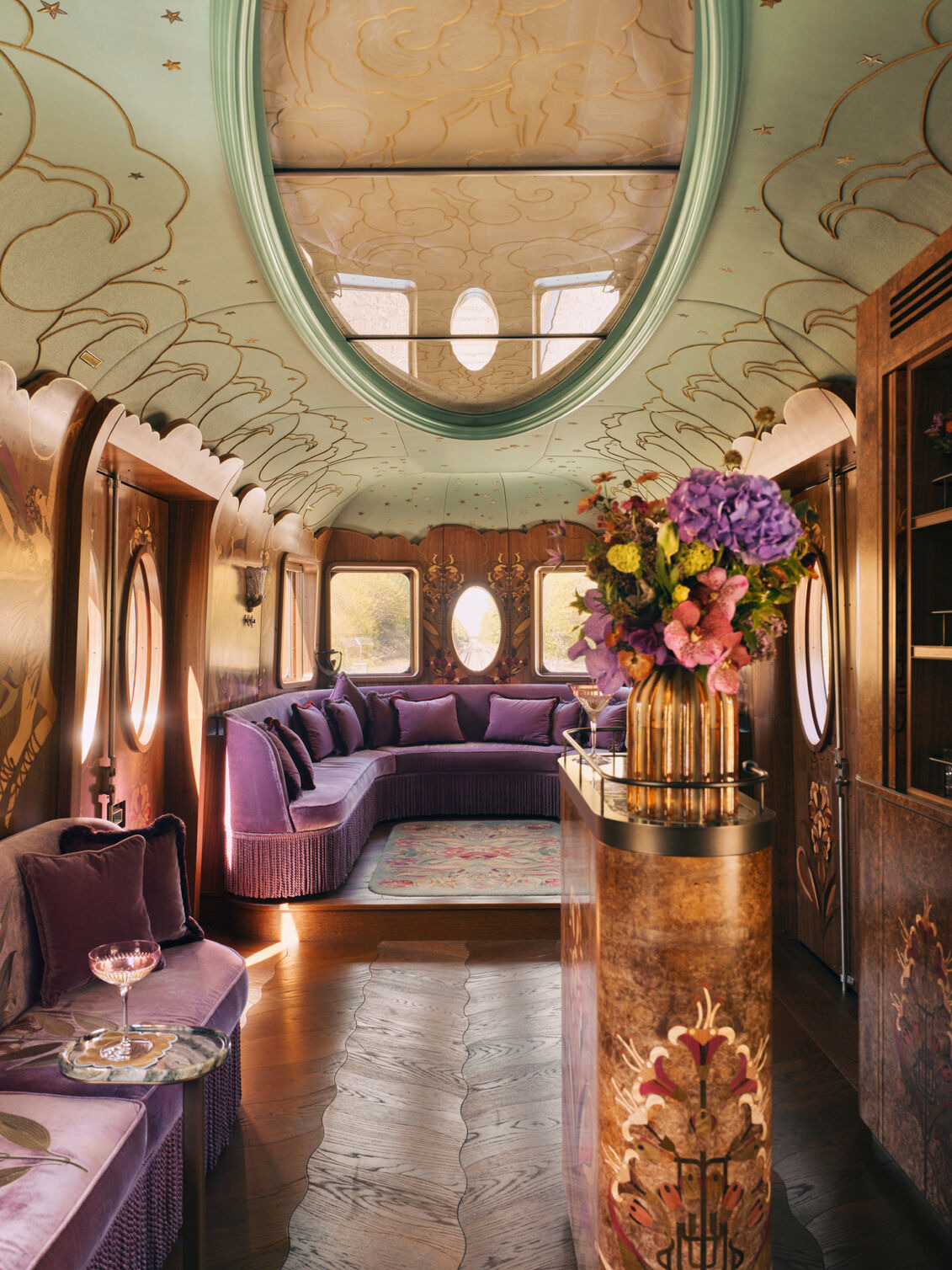
Celia draws inspiration from a broad sweep of theatrical history
Folio · Ledger · 47°49'47"S 161°05'23"E · Silver Tier
A new chapter in luxury rail travel is set to unfold in England this summer as the iconic British Pullman unveils an extraordinary new private dining and events carriage conceived by filmmaker Baz Luhrmann and…
— Club ledger, May 4, 2026, archive no. 5086